
Welcome to Early Years at GFH Alia National School
Every child at Alia is taught as an individual. Nowhere does that matter more than in the earliest years.
Children arrive at school at different stages, with different strengths, different curiosities, and different pace. Our role in early years is to know each child as an individual and to shape their first experience of school around how they actually learn.
GFH Alia National School follows an American curriculum, combined with the Bahrain Ministry of Education syllabus for Arabic, Islamic Studies, and Social Studies. The school is accredited by the Western Association of Schools and Colleges (WASC), and also holds the Inclusion Quality Mark (IQM) and ASDAN accreditation.
Our Approach
GFH Alia National School is an American curriculum school, accredited by the Western Association of Schools and Colleges and aligned with the requirements of the Bahrain Ministry of Education.
In early years, our program is informed by the principles of the Early Years Foundation Stage, the framework used by leading early years settings internationally. It places the child at the center of learning, balances structured teaching with purposeful play, and develops the whole child rather than narrow academic skills alone.
Within this approach, our teachers plan carefully, observe closely, and adapt continuously. No two children learn the same way. Our classrooms reflect that.
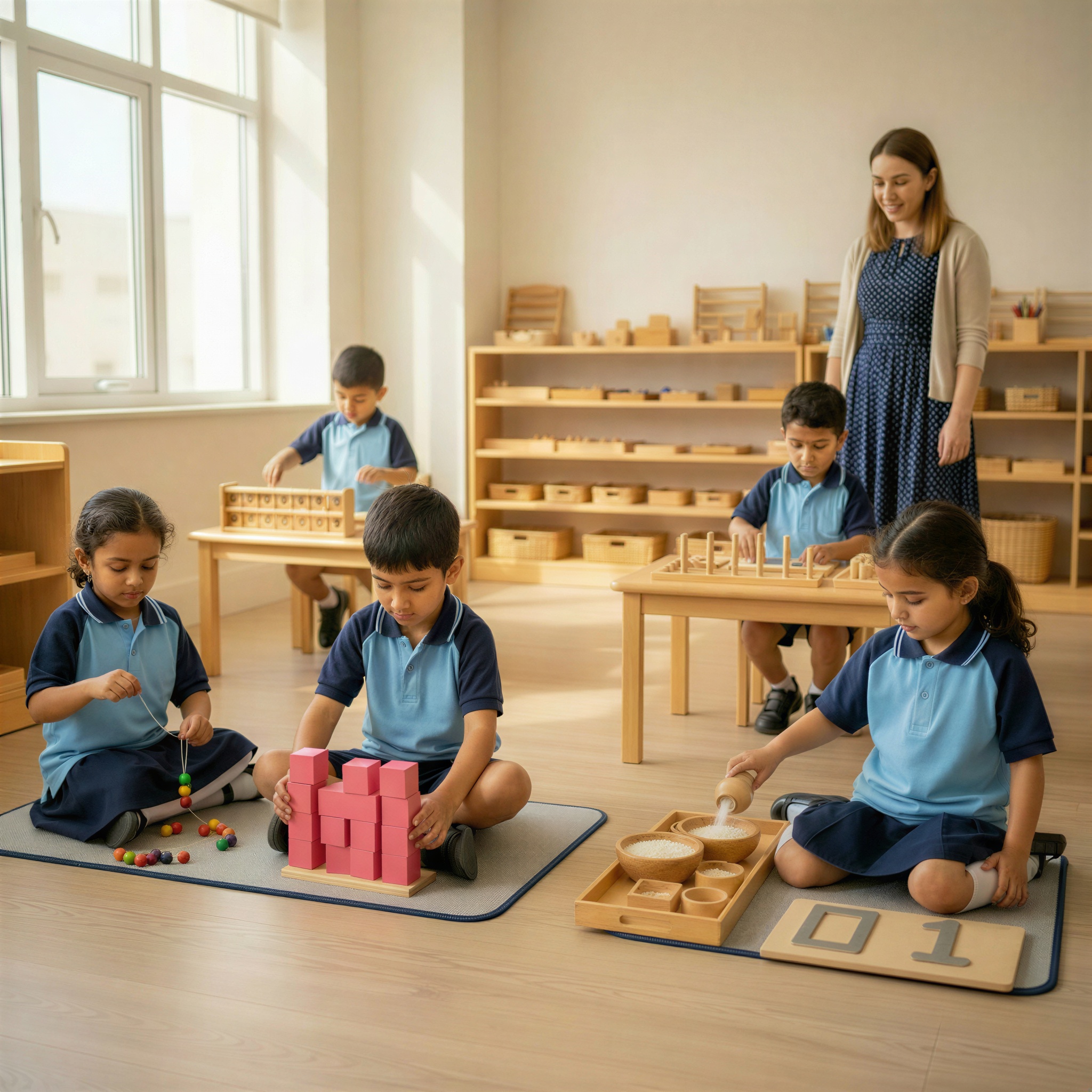
Learning through purposeful play
In our Montessori-inspired classrooms, children work at their own stations, choosing activities that build concentration, independence, and early skills at their own pace, with a teacher observing closely and guiding gently.
Integrated Areas of Development
Our program develops children across integrated areas of learning, drawn from the EYFS framework: Communication and Language, Physical Development, Personal, Social and Emotional Development, Literacy, Mathematics, Understanding the World, and Expressive Arts and Design. These are not taught as separate subjects but woven together through play, exploration, and structured teaching.
Communication, language, and early literacy
Children build vocabulary, listening, and speaking through everyday conversation, songs, stories, and rhymes. Early reading is introduced through Jolly Phonics, a structured, multi-sensory phonics program used in leading early years settings worldwide. It teaches letter sounds through actions, songs, and stories, giving children the foundation to read and write with confidence. Jolly Phonics sits within a wider literacy program that develops early writing, comprehension, and a love of books.
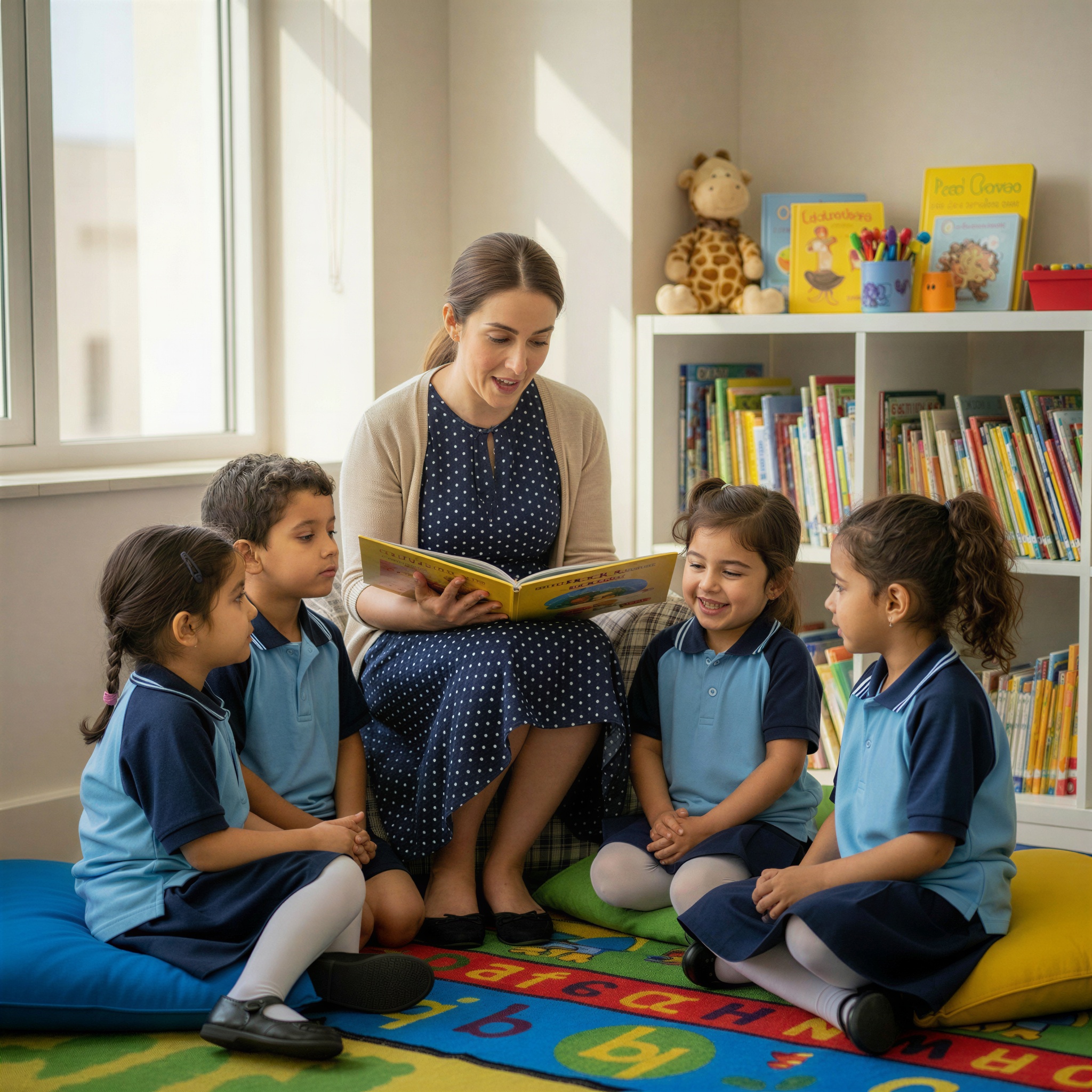
A love of language, from the very start
Daily story time builds vocabulary, listening, and imagination. Shared books, songs, and rhymes give our youngest children the foundation to read and write with confidence, and a genuine love of stories.
Arabic language and Islamic Studies
Arabic is taught daily in early years by specialist Arabic teachers, with content and pace adapted for native and non-native speakers. Islamic Studies is introduced gently through stories, values, songs, and shared routines, helping our youngest children build a strong sense of identity, belonging, and respect from their first days at school. Our Arabic and Islamic Studies provision follows the requirements of the Bahrain Ministry of Education and is delivered alongside our American curriculum, not separate from it.
Personal, social, and emotional development
Children learn to settle, to share, to take turns, to listen, and to begin understanding their own feelings and the feelings of others. Confidence, independence, and friendship are built every day. Our teachers know each child by name from the first week, and notice quickly when a child is quieter, happier, or struggling to settle. In the earliest years, being noticed matters as much as being taught.
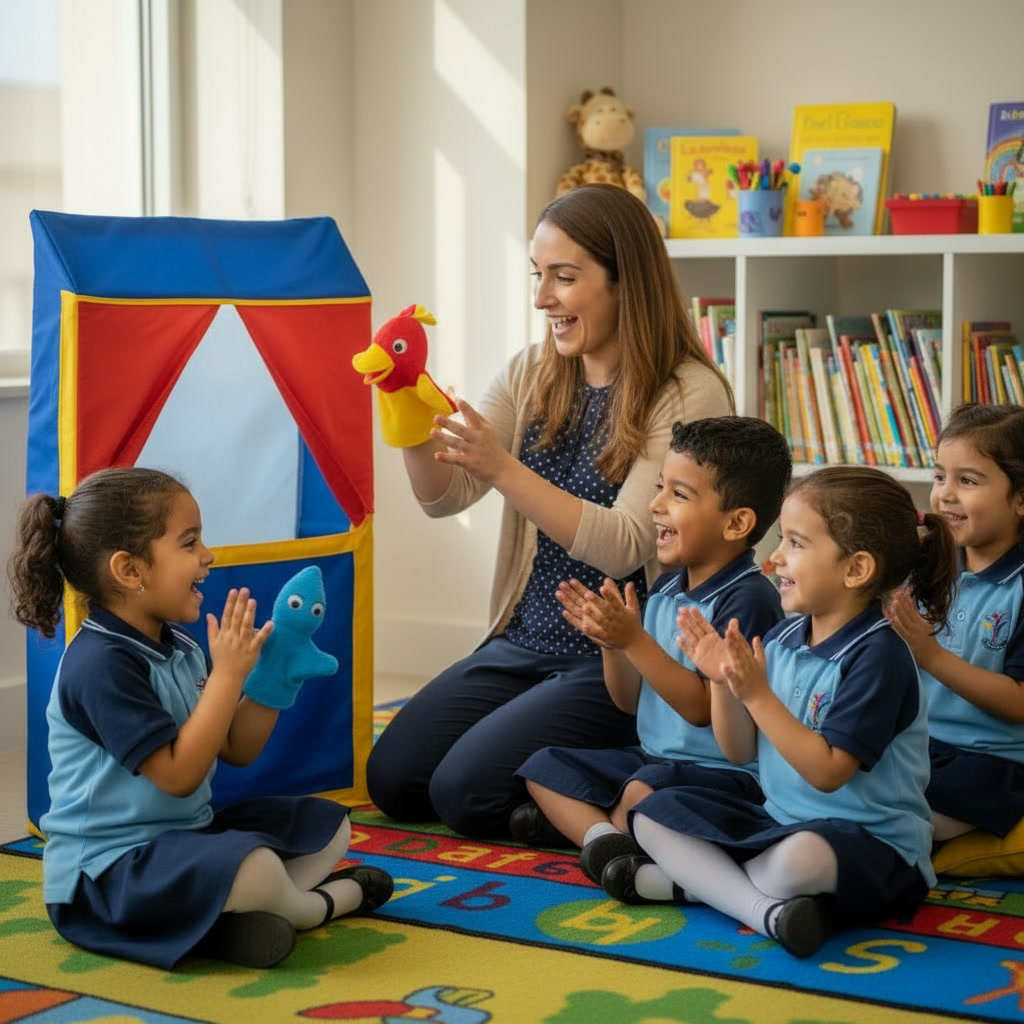
Bringing stories and feelings to life
Interactive puppet sessions help children explore language, emotions, and social skills, learning to listen, take turns, and express themselves with confidence, all through the joy of play.
Physical, creative, and cognitive development
Through movement, art, music, construction, early mathematics, and exploration of the world around them, children develop coordination, curiosity, and the early thinking skills that carry them through school. Early number concepts are introduced through practical, hands-on mathematics.
How We Teach
Four principles shape every day in our early years classrooms.
1. The child is at the center
Teaching responds to the child, not the other way round. We observe carefully, plan around what each child needs next, and adjust as they grow.
2. Play is purposeful
Children learn most deeply when they are engaged, curious, and active. Our teachers design play environments that build specific skills, while leaving room for children to explore and discover.
3. The environment is a teacher
Classrooms, indoor and outdoor learning spaces, and the materials we put in them are designed to invite curiosity, independence, and choice. What we put in front of children matters.
4. Parents are partners
The first years of school are a partnership between home and school. We communicate openly and regularly, share what we see, and invite parents into the life of the classroom.
Observation and Assessment
Play in early years is purposeful, observed, and linked to each child’s next steps. Teachers observe children during play, focused tasks, group work, and daily routines. These observations help us understand each child’s strengths, confidence, independence, language development, early literacy, early numeracy, and social skills. Planning is then adjusted so children are supported and challenged at the right level.
A Day in Early Years
A typical day in our early years classrooms balances:
- Quiet, focused activities that build attention and early academic skills
- Phonics and early reading through Jolly Phonics
- Early number concepts through practical, hands-on mathematics
- Arabic language, taught daily through songs, stories, conversation, and play
- Islamic values and stories, shared as part of the daily rhythm of the classroom
- Active, hands-on learning that develops physical coordination and curiosity
- Group time for stories, songs, and shared experiences
- Outdoor play and exploration
- Quiet time, snack, and routines that build independence
Every day is different. Every day is planned.
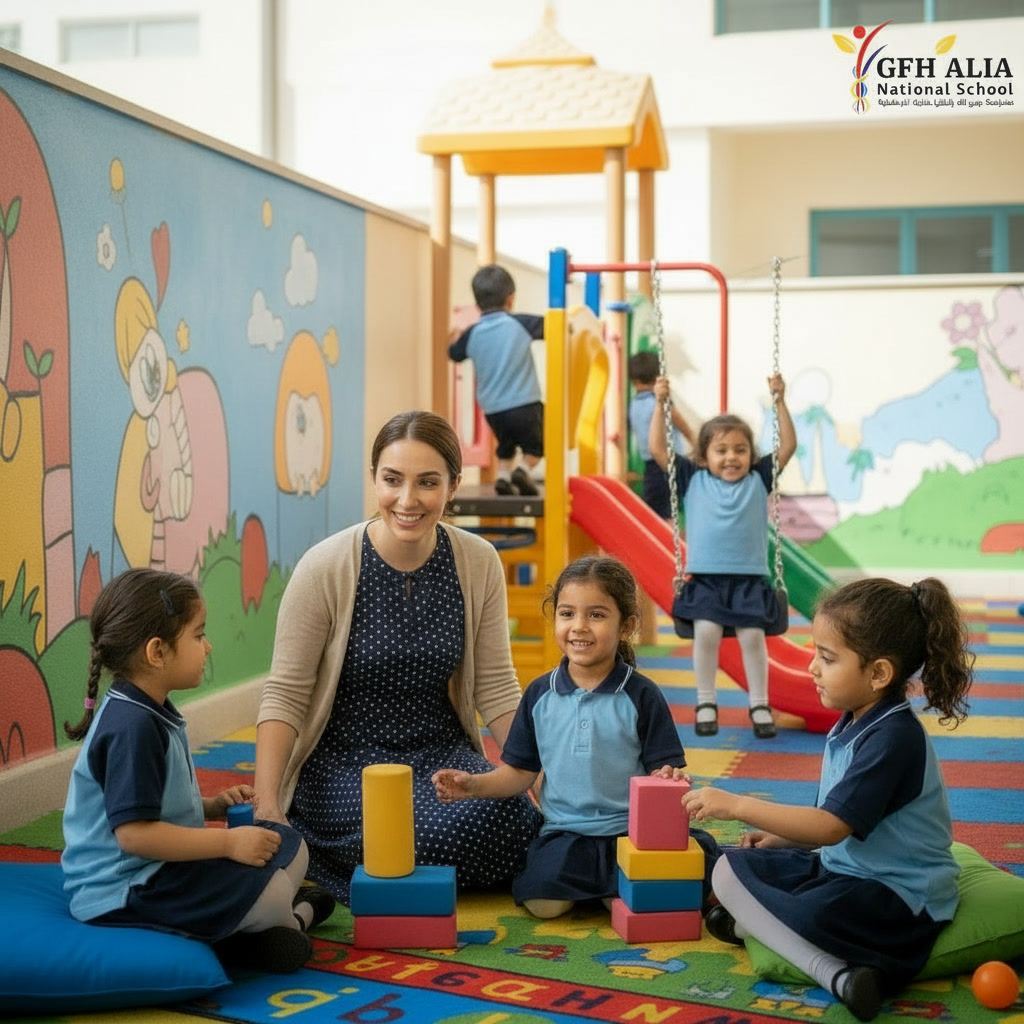
Calm focus and active play, every day
From focused classroom activities to outdoor play and exploration, each day is planned to develop the whole child: mind and body, confidence and curiosity, in a warm and safe environment.
Settling In
Starting school is a significant moment for the whole family. We work closely with parents to make the transition gentle, gradual, and confident. New families are invited to visit the classroom before the first day and meet their child’s teacher, easing the move into school life.
Visit Us
The best way to understand what early years at Alia feels like is to see it. We welcome parent visits throughout the year and would be delighted to show you our classrooms and introduce you to our team.


